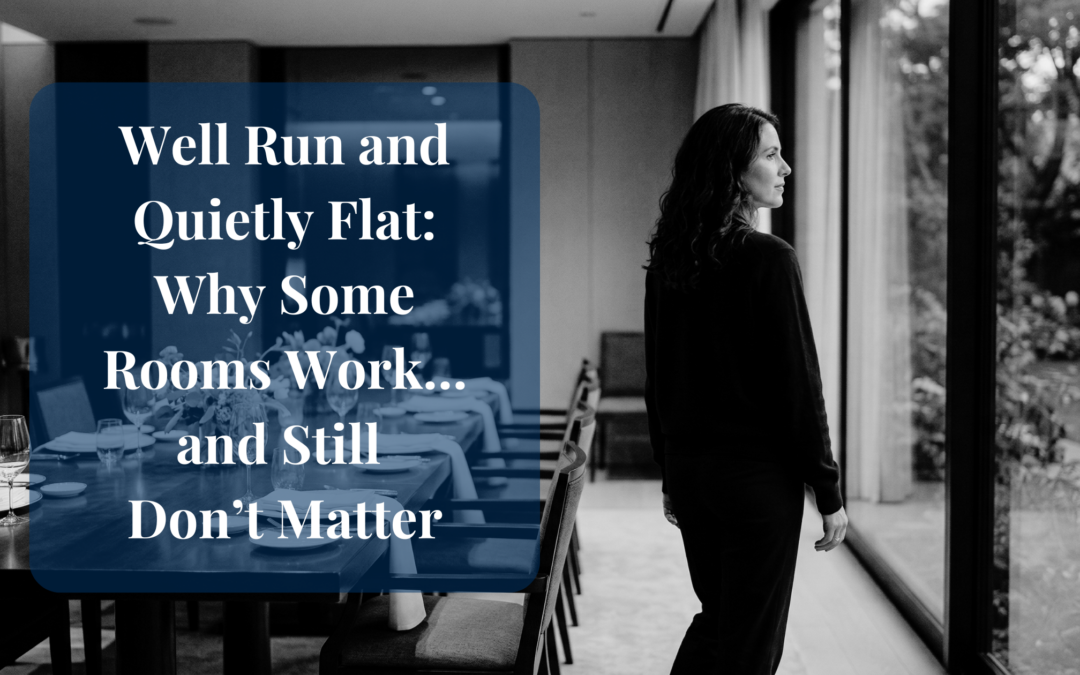
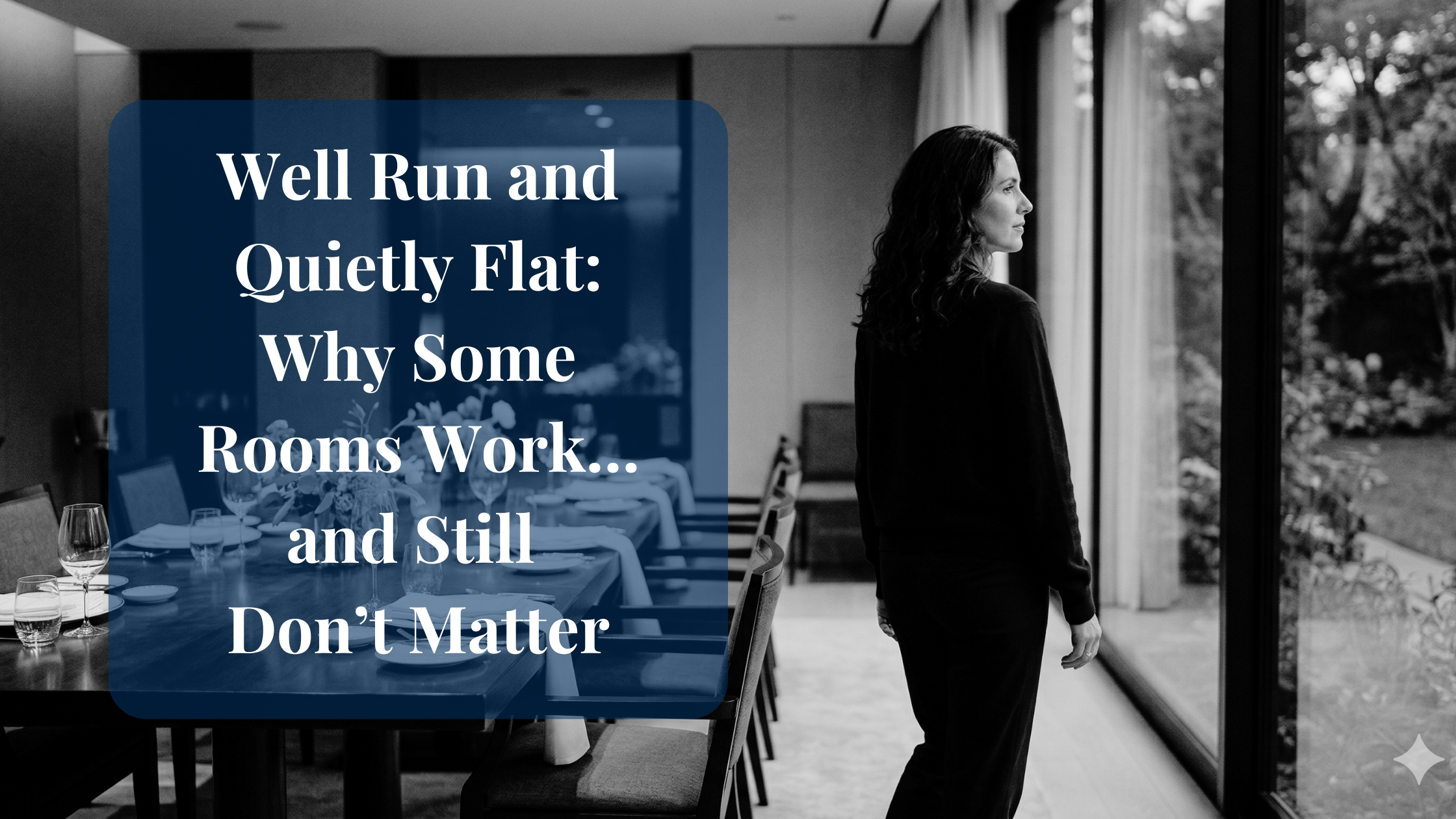
Well Run and Quietly Flat: Why Some Rooms Work… and Still Don’t Matter

Well Run and Quietly Flat: Why Some Rooms Work… and Still Don’t Matter

This post is a part of the The Significance Project. If this resonates with you, I’d love for you to be part of the community..

You can sign up here.

There is a particular way I move through the world that has become more pronounced over time.

I walk into rooms and take everything in. Not because I am looking for something wrong, but because that is how I am wired. I notice the temperature of the conversation, who is performing and who is present, whether there is room to arrive as you actually are or whether a more edited version of you is quietly required.

This way of being has shaped how I enter spaces. I prepare differently. I understand what certain rooms are for and what they cost, and I make those choices with my eyes open. At this point in my life, the rooms I choose have to earn it, not out of difficulty, but out of clarity. I know what it costs to be in the wrong one.

What’s becoming clearer is not just the ability to read a room, but the growing unwillingness to stay in ones that don’t create anything meaningful.

I have been in beautiful rooms. Expensive food, carefully chosen details, tables arranged with a level of care that signals intention. And still, the conversation remains on the surface. There is a subtle awareness of self that never quite drops away. You leave with the sense that it was pleasant, even successful, and yet nothing stays with you.

I have also been in the opposite. Gatherings assembled at the last minute, a mix of whatever people happened to bring, nothing particularly refined or coordinated. And something real happens. The conversation deepens, people say things that matter, and for a period of time you forget about yourself entirely. You leave not just having attended, but having been affected.

These are, of course, extremes. But they reveal something that is easy to miss.

A room can be well run and still be quietly flat.

Most people know exactly which rooms those are. They just haven’t stopped saying yes to them.

The distinction is not in the aesthetics or the effort. It is in what the room makes possible.

Years ago, a mentor gave me a question that reframed how I think about this entirely. We were preparing for an experience that felt significant to me, and as I often do, I was focused on execution. What to say, how to show up, how to get it right.

She interrupted that line of thinking with a different question, one that has stayed with me ever since. As we were preparing to step onto a boat, she asked, how do you want to feel when you step off?

Not how will you prepare. Not how will it go. How will you feel when it is over.

What she did in that moment was shift my attention from the front end to the residue. Not what the room looks like or how it is structured, but what remains once you leave. What you carry with you. Who you are, even slightly, because you were there.

That question has become a lens through which I now see not only gatherings, but much of life.

The people I work with are encountering this more and more. They are in rooms that are supposed to matter. Leadership groups, peer circles, curated environments designed to support growth and connection. Many of these spaces are well organized, thoughtfully run, even impressive on the surface.

And yet, if they are honest, some of them are quietly flat.

They leave thinking it was fine. They can point to what worked. And still, they notice that nothing stayed with them. No shift in thinking, no deeper connection, no meaningful movement.

The first instinct is often to internalize that experience. To wonder if they have become too particular, too discerning, or somehow less open than they once were.

But what is actually happening is something else.

They have outgrown rooms that look right but do not ask anything real of them.

This is a subtle but important threshold. It is not a rejection of gathering or community, but a refinement of what those spaces need to hold in order to be worth entering.

The people I sit with understand this. Where they place their presence and energy is deliberate. The rooms they gather in are part of the architecture of a life that is actually working.

And the most meaningful of those rooms are organized around a different question.

Not what is on the agenda. Not who else will be there.

What do I want to walk away with?

When that becomes the orienting question, everything begins to shift. The composition of the room changes. The level of honesty changes. The expectations change. You are no longer optimizing for smoothness or success in the conventional sense. You are designing for something that has the capacity to move you.

This is where I find myself.

Paying close attention to the environments that open something in me and those that cause me to contract. Noticing where I lean forward and where I become more guarded. Letting that information guide where I choose to spend my time and energy.

Before I walk into anything that matters, I ask how I want to feel when I step off the boat.

I know what I am looking for.

I will not settle for flat.

And if the room I am looking for does not exist, I will build it.

I write about what becomes possible when success stops being the only measure. The Significance Project lands in your inbox every week. It is written for founders and visionary leaders asking better questions than success alone can answer.

Come do this work with me.

Jen

Jen Karofsky | Thought Partner & Coach for Visionary Leaders & Significance Seekers

 Jen Karofsky collaborates with leaders who are ready to disrupt the status quo and craft a life of legacy, deep connection, and purposeful impact. Through intentional coaching and bold thought partnership, Jen helps you align your work, your values, and your vision to create transformational change in your world.

Join The Significance Project to redefine success and step into your power.

Join

The Significance Project

My monthly(ish) newsletter for the tools, tips and provocations you need to live your life of significance.

More on the BLG:

I AM HERE FOR THE GRAPPLERS

Explore the unique challenges and triumphs of ambitious leaders who embrace both personal and professional growth. Learn how “The Significance Project” helps leaders transform all aspects of their lives, not just their careers. Dive into our insights on holistic growth and discover how you can become a grappler, a warrior in your own life journey.
read more
God Speaks Through the Mouths of Strangers

God Speaks Through the Mouths of Strangers

This post is a part of the The Significance Project. If this resonates with you, I’d love for you to be part of the community..

You can sign up here.
On the quiet art of receiving and why the most capable among us may need it most.

This morning at the gym, I almost kept walking past a moment that stayed with me the rest of the day.

It’s loud there. Plates dropping. Music pulsing. Bodies announcing effort without apology. Strength expressed in ways that leave little room for subtlety.

And in the middle of all of it was a woman moving quietly through her own practice.

She wasn’t lifting heavy weight. She was using the machines almost like Pilates, moving slowly and with control. Her movements were focused and precise, completely absorbed in what she was doing.

She didn’t match the room.

There was something steady about her. Not fragile. Not small. Simply grounded in herself in a space that rewards spectacle.

I found myself smiling as I watched her. When I walked past, I stopped.

“There’s something really beautiful about the way you’re working.”

She looked surprised.

“Oh my goodness, thank you,” she said. “I almost didn’t come today. I don’t feel like I’m doing much.”

Then she stopped what she was doing and looked directly at me.

“God speaks through the mouths of strangers.”

I offered encouragement. She offered something back.

She almost didn’t show up. I almost didn’t speak. Somewhere between those two small decisions was a moment neither of us planned.

We tend to imagine that meaningful exchanges require depth, long conversations, shared history, context. In reality, some of the moments that stay with us most are brief. Sometimes they require only attention. A willingness to notice. A sentence offered without agenda.

Most people walk into rooms carrying something invisible: doubt, fatigue, or a quiet negotiation about whether what they are doing counts. We rarely know which part of someone’s day we are stepping into.

Attention is one of the most underestimated forces in human life.

What struck me later was the contrast of that space. All around us were visible expressions of strength, power measured in weight lifted and effort displayed. And there she was practicing something quieter. Care. Precision. The decision to show up for herself even when she almost didn’t.

She returned to her workout. I returned to mine. The music kept playing. Plates kept dropping. The room carried on as if nothing had happened.

But I left carrying her words with me. I had never heard that phrase before. And now I suspect I won’t forget it.

Here is what I have been sitting with since.

I walked over to give her something. A moment of recognition. That is my default. It is what I do.

And I suspect it is what you do too.

You are the one people call. The one who holds the shape of things when others cannot. Whether you are leading a company, founding something from a vision others can’t yet see, or simply being the person in every room who others lean toward, you have spent years developing an extraordinary capacity to give. To see people clearly. To hold space with skill and intention.

You are, in the truest sense, a high capacity person.

And most of you have been training that muscle your entire lives. Often since long before anyone gave it a name. Being the reliable one. The perceptive one. The one who figures it out. Decades of quiet, invisible reps.

What we rarely talk about is the other side.

Because while you were busy becoming exceptional at giving, most of you never developed an equally strong muscle for receiving. Not because you are closed or broken. But because nobody told you it required practice. Receiving looks passive. It looks like simply accepting things gracefully. So most high capacity people assume it will happen naturally.

It doesn’t.

Receiving is a skill. And like any underdeveloped muscle, when it gets called on unexpectedly it can feel strange. Uncomfortable. Almost foreign.

I have stood in many rooms full of helpers. Coaches, consultants, leaders, healers, founders, visionaries. Rooms full of people with enormous capacity to give. And what I notice, again and again, is that most of them are quietly hungry. Not for more to give. For something to receive. For someone to meet them with the same quality of attention they offer everyone else.

It is a particular kind of loneliness. Not loneliness for company. They have plenty of that. Loneliness for reciprocity. To be seen the way they see others. To be held the way they hold others.

And here is the quiet irony. The very skills that make you exceptional at giving can make you harder to reach. You are so capable, so composed, so visibly strong that the people around you stop looking. Stop offering. Why would she need anything? She has it together.

So the people closest to you often give you the least.

And then a stranger, with no context and no history and nothing to prove, accidentally does what the people who know you best stopped doing long ago.

So what does receiving actually require?

It requires setting down, just briefly, the identity of the one who has it together. For high capacity people this is often the hardest part. You have spent years, perhaps a lifetime, being the resource. The one who holds. The one who figures it out. Receiving asks you to be something else for a moment. Not less. Just different. And that can feel surprisingly uncomfortable for someone whose strength is so practiced.

It requires presence. Real presence. Truly receiving something, a compliment, a gesture, a phrase that reframes your world, means staying in the moment long enough for it to actually land. Most high capacity people are already three steps ahead. Receiving asks you to stop. Just for a moment. Let it in without immediately processing it, returning it, or moving past it.

It requires trusting that you are worth giving to. Many skilled givers unconsciously filter what comes toward them. They don’t really know me. They’re just being kind. It doesn’t really count. That filtering feels like discernment. But often it is just an old habit of making yourself smaller than the moment being offered.

And it requires the willingness to be both. Capable and nourished. Strong and reachable. A giver who also receives. These are not opposites. But for many high capacity people, holding both takes deliberate practice.

The practice does not begin with grand gestures or profound exchanges.

It begins with small things.

Letting a compliment land instead of deflecting it. Sitting with someone’s kind words for three full seconds before moving on. Noticing when you immediately reciprocate a compliment rather than simply receive it, because immediate reciprocity is often just a more elegant form of deflection.

It begins with becoming as intentional about receiving as you have always been about giving.

Because here is what becomes possible when you do.

You expand. You round out. You begin to understand from the inside what the people you serve are navigating. You access perspectives and forms of nourishment that your giving muscle, no matter how strong, could never reach on its own.

And something that has quietly been missing starts to come back online. Not just as a practitioner or a leader or a founder. As a human being living a whole life.

That woman in the gym did not know she was offering me a new lens. She was just being honest about her own experience, the way people sometimes are when a stranger catches them off guard with a moment of genuine attention.

But I received it. I let it land. I carried it with me.

And I am still sitting with it now.

“God speaks through the mouths of strangers.”

Maybe the practice begins with becoming the kind of person who is still open enough to hear it.


Jen Karofsky | Thought Partner & Coach for Visionary Leaders & Significance Seekers

 Jen Karofsky collaborates with leaders who are ready to disrupt the status quo and craft a life of legacy, deep connection, and purposeful impact. Through intentional coaching and bold thought partnership, Jen helps you align your work, your values, and your vision to create transformational change in your world.

Join The Significance Project to redefine success and step into your power.

Join

The Significance Project

My monthly(ish) newsletter for the tools, tips and provocations you need to live your life of significance.

More on the BLG:

I AM HERE FOR THE GRAPPLERS

Explore the unique challenges and triumphs of ambitious leaders who embrace both personal and professional growth. Learn how “The Significance Project” helps leaders transform all aspects of their lives, not just their careers. Dive into our insights on holistic growth and discover how you can become a grappler, a warrior in your own life journey.

read more
Ambition, Power, and the Art of Holding the Reins

Ambition, Power, and the Art of Holding the Reins

This post is an excerpt from The Significance Project. If this resonates with you, I’d love for you to be part of the community..

You can sign up here.

banner to represent authorship

On the moment when achievement stops being the destination and becomes the foundation

The Symbolism of the Horse

There has been renewed attention lately on the Year of the Horse. Conversations about power, movement, and forward momentum have become more visible. Whether or not one follows the lunar calendar, the symbolism has resonated.

The horse represents strength, vitality, and direction. It is alive and in motion.

That image resonates deeply for me.

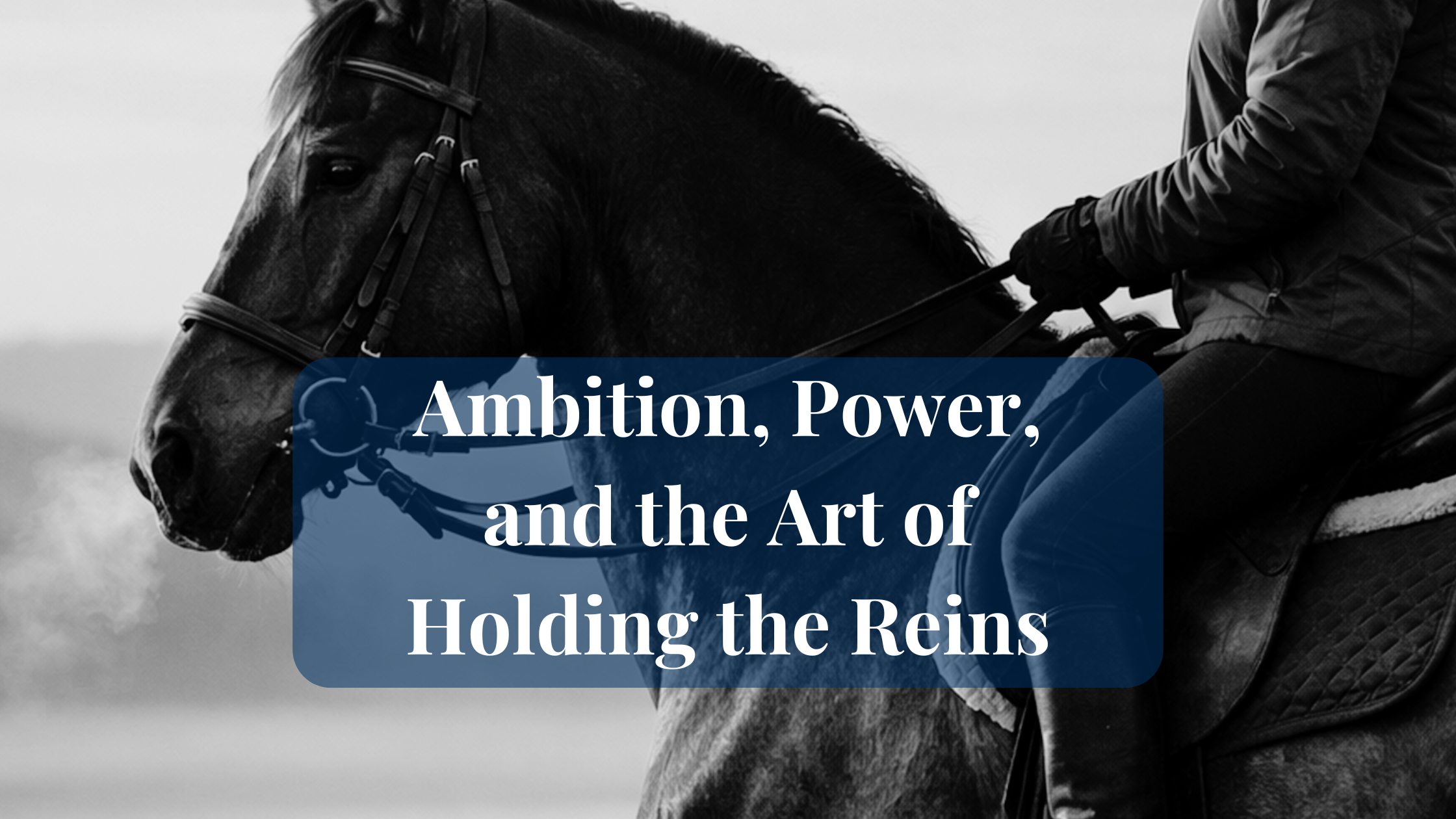
I started riding when I was seven. My first exposure was through vaulting, where balance and trust came before traditional riding techniques. Horses have been part of my life ever since. There is still something sacred about being near them. The scent of the barn. The sound of hooves on the ground. The feeling of breath moving through a powerful body.

And yes, I loved the gallop. That moment when motion overtakes stillness and the wind seems to carry you forward.


Learning to Hold Power Differently

Over time, I learned something important. The real art is not found in the gallop. It lives in how the reins are held.

Not in controlling power, but in being in relationship with it. Present. Steady. Honest.

This increasingly reflects a point many people arrive at once capacity has been built and responsibility is real.


Success Still Matters

This is not a critique of success. Success matters. It is hard earned. It supports families and communities. It funds generosity. It creates choice.

Many people spend decades building something meaningful, and that effort deserves respect. Being resourced matters. Capability matters. Direction matters.


When Success Becomes the Foundation

At a certain point, success stops being the final destination and becomes the foundation instead. There is often an internal moment, sometimes quiet and sometimes startling, when the realization arrives: I made it. Now what.

This is not collapse or failure. It is evolution.

At a certain point, success reaches the limit of what it alone can offer. What follows can feel disorienting, not because success was wrong, but because the person has outgrown measuring meaning with a single metric.

This is where significance begins to emerge. Not as a rejection of success, but as an expansion of it. The same story continues, only at a deeper level.


From Achievement to Alignment

Time spent building achievement matters. It forms character. It builds resilience. It proves capability.

But eventually, speed alone stops feeling like aliveness. A quieter question rises. Where is all of this meant to go now?

The focus shifts from external markers toward internal coherence. The question becomes less about winning and more about becoming.

This is the developmental edge. The place where success matures into meaning.


A Different Kind of Power

If we stay with the cultural lens of the past year, shedding and release were central themes. Letting go of identities and roles that once fit but no longer do. That work is often uncomfortable and largely unseen, but it matters.

The Horse invites something different. Not acceleration for its own sake, but intention. Movement with direction. A more conscious relationship with power.

Capacity remains. Momentum remains. But urgency gives way to clarity.


Success and Significance Together

In this sense, success is the gallop. Significance is remembering why the horse was chosen in the first place.

Success builds capacity. Significance gives that capacity purpose.

Many people stand right here. Capable. Responsible. No longer interested in motion that lacks meaning.

Nothing is broken. Something is maturing.


What Comes Next

This is the moment that matters most to me. When success becomes the platform rather than the prize. When capacity deepens into stewardship rooted in integrity, contribution, and a life that feels internally accurate.

Some of the strongest memories I have from riding are not of speed, but of stillness before movement. The horse beneath me awake. My body steady. The next step present, but not yet taken.

The strength exists without urgency. It does not need to rush.

If a subtle internal shift is being noticed, a restlessness, or a pull toward deeper alignment, nothing is wrong.

Power may simply be asking to be held differently now.

Success will always matter.
What we do with it is where life deepens.

And learning to hold the reins, rather than outrun ourselves, may be the beginning of significance. The place where success deepens into meaning.

Jen Karofsky | Thought Partner & Coach for Visionary Leaders & Significance Seekers

 Jen Karofsky collaborates with leaders who are ready to disrupt the status quo and craft a life of legacy, deep connection, and purposeful impact. Through intentional coaching and bold thought partnership, Jen helps you align your work, your values, and your vision to create transformational change in your world.

Join The Significance Project to redefine success and step into your power.

Join

The Significance Project

My monthly(ish) newsletter for the tools, tips and provocations you need to live your life of significance.

More on the BLG:

I AM HERE FOR THE GRAPPLERS

Explore the unique challenges and triumphs of ambitious leaders who embrace both personal and professional growth. Learn how “The Significance Project” helps leaders transform all aspects of their lives, not just their careers. Dive into our insights on holistic growth and discover how you can become a grappler, a warrior in your own life journey.

read more
Using Your Place Well In A Loud World

Using Your Place Well In A Loud World

This post is an excerpt from The Significance Project. If this resonates with you, I’d love for you to be part of the community..

You can sign up here.

banner to represent authorship

The world feels incredibly loud right now.

History is being made in real time. Power structures are shifting. Entire futures are being rearranged. There is a level of collective witnessing—often through constant headlines, images, and commentary—that the nervous system was never designed to hold all at once.

It’s a lot to carry.

When the world feels this overwhelming, I notice my system wants to do one of two things:
go numb, or rush into urgent action.

Neither response feels like my best self.

So I return to a question that helps me stay grounded, awake, and useful:

Am I using my place well?

What It Means to “Use Your Place Well”

This question isn’t about grand gestures or performative action.
It’s about the ways we actually know how to contribute.

Using your place well means:

  • Acting from your real skills, not borrowed urgency

  • Staying resourced enough to sustain your effort

  • Taking responsibility without carrying what isn’t yours

We don’t have to carry everything.
But we do have to carry what is ours.

For me, this question is rooted in a belief system I was raised inside. I grew up with the concept of tikkun olam—the idea of participating in the repair of the world. Not alone. Not perfectly. But collectively.

That framework has shaped how I understand responsibility:
remaining connected to the world without being swallowed by it.

Why Place Is Never Neutral

“Place” isn’t neutral.

It includes:

  • Where you’re born

  • The freedoms you inherit

  • The obstacles that shape you

  • The access you have—and the access you don’t

Education.
Stability.
Resources.
Safety.
Time.

Some of this is given. Some of it is built.
All of it carries responsibility.

When you have access, stability, or time that isn’t consumed by survival, neutrality isn’t an option. Not because you’re exceptional—but because this is the position you’re standing in.

Different Responses to a Loud World

When the world gets loud, people respond differently.

Some move quickly. They speak. Decide. Commit. Act.
Sometimes that speed is integrity—the relief of knowing exactly where to place your energy.

Other times, it’s adrenaline. Motion that feels like purpose at first but leads to depletion later. Not because the cause doesn’t matter, but because the nervous system can only sprint for so long.

Others move more slowly. They watch. Listen. Gather information.
Sometimes that pace is self-protection.
Sometimes it’s discernment—a refusal to rush into borrowed action before clarity arrives.

Neither response is automatically better.

Both are attempts to stay human while deciding how to show up.

Leadership Isn’t Just About Action

This tension doesn’t only appear during global crises.
It shows up quietly, too—in leadership roles, in work, in relationships, in moments when you realize your position matters and you want to use it well.

Leadership isn’t just about doing more.
It’s about choosing how to act from your actual place.

That’s where this question continues to guide me:

Am I using my place well?

Not to have the perfect answer.
But to stay grounded enough to respond with clarity, responsibility, and care.

Jen Karofsky | Thought Partner & Coach for Visionary Leaders & Significance Seekers

 Jen Karofsky collaborates with leaders who are ready to disrupt the status quo and craft a life of legacy, deep connection, and purposeful impact. Through intentional coaching and bold thought partnership, Jen helps you align your work, your values, and your vision to create transformational change in your world.

Join The Significance Project to redefine success and step into your power.

Join

The Significance Project

My monthly(ish) newsletter for the tools, tips and provocations you need to live your life of significance.

More on the BLG:

I AM HERE FOR THE GRAPPLERS

Explore the unique challenges and triumphs of ambitious leaders who embrace both personal and professional growth. Learn how “The Significance Project” helps leaders transform all aspects of their lives, not just their careers. Dive into our insights on holistic growth and discover how you can become a grappler, a warrior in your own life journey.

read more
Peace Isn’t Quiet: Redefining Inner and Outer Peace in Uncertain Times

Peace Isn’t Quiet: Redefining Inner and Outer Peace in Uncertain Times

This post is an excerpt from The Significance Project. If this resonates with you, I’d love for you to be part of the community..

You can sign up here.

banner to represent authorship

The world is not subtly shifting. It is shaking visibly, audibly, and in real time. Violence is erupting, opinions are colliding, history feels exposed, and fear is no longer hidden beneath the surface. Everything feels present and immediate.

In the middle of all of this, I noticed something unexpected in myself.

Not calm. Not serenity.

But a steady alertness that feels deeply aligned.

Peace as Wakefulness, Not Escape

I don’t feel anxious. I feel awake.

That distinction matters. What I’m experiencing doesn’t feel accidental or circumstantial. It feels earned. Built over years of paying attention, strengthening capacity, and learning how to stay present without collapsing or hardening. This isn’t luck. It’s inner architecture.

Something in me is saying: pay attention.

Holidays often mark personal thresholds, but this year the threshold feels collective and visible. Rather than pulling me inward toward quiet or retreat, this season is calling me toward engagement a grounded presence that stays with reality instead of softening it.

The peace I’m experiencing right now doesn’t arrive after disturbance.
It rises within it.

It has movement.
It has heat.
It’s alive.

And at first, that realization startled me.

When Peace Doesn’t Match the Story We Were Told

I grew up believing peace looked like stillness. Quiet mornings. Resolution. The absence of friction.

This peace doesn’t look like that.

Last week, I sat with my father, who at ninety carries his wisdom with a clarity I trust. I told him something was stirring in me that I couldn’t yet name. He listened, then said simply:

“To thine own self be true.”

Then he added something practical: sometimes the best decision is no decision at all. Waiting can still contain movement. Sitting with something doesn’t mean nothing is happening.

That landed deeply.

The restlessness I feel isn’t something to fix. It’s a signal. Something in me is stretching toward deeper alignment. Something wants more voice. More truth.

And I’m hearing echoes of this everywhere.

The Early Language of Change

Others are naming it too the questioning, the discomfort that feels purposeful rather than chaotic. This doesn’t feel like random noise. It feels like the early language of change.

As the year closes, I’m letting myself stay with the signal. I’m letting peace move rather than settle. I’m letting it stay alive rather than forcing it into silence.

If you’re feeling something rising—something clarifying or nudging or rearranging—I hope you let yourself notice it. Not to rush into urgency. Not to force a decision.

But to consider this possibility:

Peace may not look tranquil in this season of life.


The Peace We Build Together

After reflecting on peace as something alive within me, I started paying closer attention to how peace forms between people.

What I keep noticing is this: inner peace and outer peace are not separate experiences. They shape each other. They unsettle each other. They make each other possible.

Research on co-regulation shows that our nervous systems respond to one another. We calm in the presence of regulated systems and activate around activated ones. Inner and outer peace aren’t just philosophically connected they are neurobiologically braided.

When I feel steady inside myself, I show up differently with others.
And when I experience genuine connection, my inner steadiness deepens.

Peace Is About Contact, Not Performance

This season can create pressure to feel grateful, joyful, inspired, calm. It can also create pressure to appear peaceful, even when what we’re holding is complex.

I’m not interested in appearances this year.
I’m interested in contact.

If peace is alive and evolving within us, then outer peace must be alive too. It shows up in how we speak and listen, how we stay present when discomfort or difference enters the room. It shows up in how much truth we allow.

I see something emerging right now a desire to live more honestly, to stop smoothing ourselves into outdated expectations. There is energy in that. Integrity in that.

There is peace in that.

Peace as Practice, Not Destination

This moment isn’t only about reflection. It’s about orientation. It’s asking us how we want to be in a relationship with ourselves, with each other, with the world as it is.

So instead of offering direction, I want to offer space.

Peace is shaped in the space between us.
We learn it there.
We practice there.

Outer peace isn’t a performance.
It’s a practice.

As we step into a new year, I’m not expecting peace to arrive as stillness.

I’m expecting it to arrive as a movement.

Inner peace and outer peace are braided.
This may not be universal.
It’s simply what feels true right now.

Love + wholeness

Jen Karofsky | Thought Partner & Coach for Visionary Leaders & Significance Seekers

 Jen Karofsky collaborates with leaders who are ready to disrupt the status quo and craft a life of legacy, deep connection, and purposeful impact. Through intentional coaching and bold thought partnership, Jen helps you align your work, your values, and your vision to create transformational change in your world.

Join The Significance Project to redefine success and step into your power.

Join

The Significance Project

My monthly(ish) newsletter for the tools, tips and provocations you need to live your life of significance.

More on the BLG:

I AM HERE FOR THE GRAPPLERS

Explore the unique challenges and triumphs of ambitious leaders who embrace both personal and professional growth. Learn how “The Significance Project” helps leaders transform all aspects of their lives, not just their careers. Dive into our insights on holistic growth and discover how you can become a grappler, a warrior in your own life journey.

read more
What to Do When Self-Development Practices Stop Working: A Guide to Rebuilding Your Routine

What to Do When Self-Development Practices Stop Working: A Guide to Rebuilding Your Routine

This post is an excerpt from The Significance Project. If this resonates with you, I’d love for you to be part of the community..

You can sign up here.

banner to represent authorship

How to Evolve Your Journaling, Routines, and Self-Development Practices

Most people start a self-development practice with the best intentions. Journaling. Meditation. Morning routines. Gratitude lists. Productivity systems. We’re told that if we just follow the structure—exactly as instructed—we’ll grow, heal, and become more grounded.

But what happens when the practice stops working?

What happens when the journaling method that “should” help you feels flat? When the morning routine everyone swears by feels like a cage? When the structure that worked for someone else stops working for you?

If you’ve ever wondered why your self-development practice feels stagnant—or why it quietly stopped feeling nourishing—this is for you.

Why Traditional Journaling or Productivity Systems Stop Working

For years, I tried journaling the way I was supposed to:

  • Daily entries
  • Linear structure
  • Gratitude lists
  • Morning pages
  • The pre-designed systems everyone recommends

And at first, it helped. It gave me a container. A reminder to pause, reflect, and pay attention. But the longer I used other people’s structures, the more I felt like I was thinking in someone else’s handwriting.

Not wrong. Just… not mine.

Many people experience this and assume it’s a lack of discipline, focus, or consistency. But more often, the real reason is this:

You’ve outgrown the structure.

Or worse

It was never designed for the way your mind actually works.

The Real Reason Your Practice Feels “Off”

Some people think in straight lines. Some don’t.

My brain moves laterally. Intensely. In spirals. In deep dives and long pauses. I needed a system that could move with me—not hold me in place.

When a practice stops working, it’s rarely a personal failure. It’s usually a sign that:

  • You’ve changed.
  • Your needs have changed.
  • The structure no longer matches your season of life.
  • You’re ready for a more flexible, self-designed approach.

This is a threshold moment. A point in personal growth where the old container no longer fits the person you’re becoming.


How to Build Practices That Actually Fit You

Instead of forcing myself into a rigid routine, I started assembling what I now think of as a modular practice—a system built from pieces that meet me where I am.

Here’s what that looked like:

  • Digital notes when ideas moved fast
  • Handwritten entries when I needed grounding
  • No rules about frequency
  • No guilt when I skipped a day
  • A journal I could rearrange, add to, remove from
  • Space for evolution, not perfection

It wasn’t about finding the right system.
It was about creating one that matched how my mind naturally works.

This is what most people never learn:

The best practices are built—not adopted.


Why You’re Not Failing When a Routine Stops Working

In personal development, people often quit quietly. Not because they’re lazy or inconsistent, but because the structure starts to feel like performance instead of practice.

I see it all the time:

  • Someone tries meditation and can’t quiet their mind
  • Someone adopts a morning routine and feels constrained
  • Someone uses a meal plan or workout template that starts strong but fizzles out
  • Someone follows a productivity method that eventually suffocates their creativity

From the outside, it looks like they “gave up.”
But internally, something deeper is happening:

They’re recognizing the need for a new container.

A structure that breathes.
A process that evolves.
A practice that belongs to them, not the person who created the template.


Self-Development Practices Are Supposed to Evolve

Here’s the truth most “10-step routine” gurus won’t say:

What works today won’t work forever. And it’s not supposed to.

Your needs shift.
Your mind changes.
Your life season evolves.

Systems stop working not because you’re doing something wrong, but because you’re growing.

In fact, the evolution is the practice.

If Your Practice Isn’t Working, Try This

Instead of forcing yourself to stay inside a container that no longer fits, try this:

  • Take what resonates.
  • Leave what doesn’t.
  • Mix methods.
  • Build in flexibility.
  • Let your structure be modular, not monolithic.
  • Trust what you assemble.
  • And trust that it will change again.

Nothing is broken.
You’re simply being asked to design something that matches who you are now—not who you were when you started.

This is the art of sustainable growth.

Search Intent Tie-In: Why This Matters in Productivity, Journaling, and Mindset Work

People searching for:

  • “Why my journaling practice stopped working”
  • “How to create a journaling method that fits me”
  • “Why traditional routines don’t work for neurodivergent thinkers”
  • “How to build a personal growth practice that lasts”
  • “What to do when your morning routine stops working”

…are all asking the same deeper question:

How do I create a practice that supports who I am—not who someone else says I should be?

This is the answer.

Your Practices Get to Evolve—Because You Do

The longevity of a practice doesn’t determine its value.
The alignment does.

If you feel yourself drifting from the system that once helped you, that isn’t failure.
It’s awareness.

A sign of evolution.
A doorway into something truer.
A chance to build again—this time with parts that actually fit.

Love + Evolution

Jen Karofsky | Thought Partner & Coach for Visionary Leaders & Significance Seekers

 Jen Karofsky collaborates with leaders who are ready to disrupt the status quo and craft a life of legacy, deep connection, and purposeful impact. Through intentional coaching and bold thought partnership, Jen helps you align your work, your values, and your vision to create transformational change in your world.

Join The Significance Project to redefine success and step into your power.

Join

The Significance Project

My monthly(ish) newsletter for the tools, tips and provocations you need to live your life of significance.

More on the BLG:

I AM HERE FOR THE GRAPPLERS

Explore the unique challenges and triumphs of ambitious leaders who embrace both personal and professional growth. Learn how “The Significance Project” helps leaders transform all aspects of their lives, not just their careers. Dive into our insights on holistic growth and discover how you can become a grappler, a warrior in your own life journey.

read more